
Empire Crypto: Ultimate Smart Guide to Crypto Wallets
Welcome to the Empire Crypto: Smart Guide to Crypto Wallets—your definitive blueprint for understanding, securing, and optimizing digital asset storage in Web3. At Empire Crypto, our mission is to cut through technical jargon and empower everyday investors with actionable insights. Whether you are taking your first steps into decentralized finance (DeFi) or seeking institutional-grade security.
What Is a Crypto Wallet?
The single biggest misconception among crypto beginners is that digital wallets store actual coins inside them, similar to leather cash wallets holding paper bills.
In reality, your cryptocurrency never leaves the blockchain. Tokens exist solely as cryptographic ledger entries distributed across thousands of decentralized nodes worldwide. A crypto wallet does not hold coins; instead, it holds the cryptographic keys that grant you access to authorize transactions on that ledger.
The Two Keys You Must Understand
To interact with any blockchain network, your wallet manages two complementary mathematical keys derived from complex cryptography:
- Public Key (Public Address): This is equivalent to your bank account number or email address. You can share it freely with anyone who wants to send you funds. It identifies your unique location on the blockchain ledger.
- Private Key: This is equivalent to your digital signature, banking password, and physical vault key combined. Whoever holds the private key exercises total ownership over the funds associated with the corresponding public address.
According to research by Empire Crypto, over 80% of beginner asset losses occur not because a blockchain network was hacked, but because users mishandled their private keys or compromised their recovery seed phrases.
Custodial vs. Non-Custodial Wallets: Who Holds the Keys?
When selecting a wallet, the first structural decision is choosing between custodial and non-custodial architectures. This choice determines who possesses ultimate authority over your assets.
Custodial Wallets (Hosted Wallets)
A custodial wallet is managed by a centralized third party—typically a cryptocurrency exchange or institutional custodian. When you leave assets on a platform, the provider manages the private keys on your behalf.
- Pros: Easy setup, familiar user experience with password resets, and seamless access to instant spot trading.
- Cons: Counterparty risk. If the platform faces regulatory freezes, technical outages, or insolvency, your access to funds can be locked instantaneously.
- Famous Axiom: “Not your keys, not your coins.”
Non-Custodial Wallets (Self-Custody Wallets)
A non-custodial wallet puts total control directly into your hands. The wallet application generates private keys locally on your device without transmitting them to a central server.
- Pros: Absolute sovereignty, censorship resistance, global access, and direct interaction with smart contracts and Web3 dApps.
- Cons: Zero customer support. If you lose your seed phrase or expose your private key to a phishing site, no company on earth can reverse the transaction or restore your account.
The team at Empire Crypto always emphasizes that while custodial exchanges serve as convenient entry gateways for fiat onboarding, long-term wealth preservation requires mastering self-custodial tools.
Hot Wallets vs. Cold Wallets: Securing Your Risk Profiles
Beyond ownership structures, crypto wallets are categorized by their connectivity status: Hot Wallets (online) and Cold Wallets (offline).
| Feature Category | Hot Wallets (Software Storage) | Cold Wallets (Hardware & Offline Vaults) |
| Internet Connection | Always connected to Web3 networks | Completely isolated / Offline air-gapped |
| Primary Use Case | Daily DeFi trading, NFT minting, micro-transacting | High-value HODLing, treasury preservation |
| Security Risk Level | Moderate to High (Malware, Phishing, Drainers) | Maximum (Immunized against remote web exploits) |
| Setup Cost | Usually Free (Open-source apps) | $60 – $250+ for dedicated hardware devices |
| Transaction Speed | Instantaneous signing | Requires manual physical device confirmation |
Understanding Hot Wallets
Hot wallets operate on internet-connected devices such as smartphones, laptops, or browser extensions.
- Browser Extension Wallets: Ideal for connecting to Web3 dApps, decentralised exchanges, and staking protocols. Examples include MetaMask, Phantom, and Rabby.
- Mobile Apps: Convenient software applications for sending everyday peer-to-peer payments on the go. Examples include Trust Wallet, Coinbase Wallet, and Exodus.
- Desktop Applications: Comprehensive software suites installed on personal computers offering detailed portfolio tracking and local key generation.
Understanding Cold Wallets
Cold wallets keep private key generation and transaction signing entirely off internet-connected hardware.
- Hardware Devices: Purpose-built physical devices featuring secure elements (EAL6+ chips). Transactions are constructed on an online computer, transferred to the hardware device via USB or Bluetooth, signed offline inside the isolated chip, and sent back as a signed string to broadcast to the network. Prominent brands include Ledger and Trezor.
- Air-Gapped Hardware: Ultra-secure cold devices that communicate exclusively through QR code scanning or microSD cards, avoiding physical wire or wireless connections altogether.
- Paper & Steel Storage: Physical mediums where seed phrases or private key pairs are etched onto stainless steel plates or written on paper stored in fireproof safes.
At Empire Crypto, we classify wallet security into tiers: treat hot wallets like a physical leather pocket wallet for daily spending, and cold wallets like a subterranean bank vault for life savings.
Empire Crypto 4-Step Framework for Wallet Setup
Setting up a self-custodial wallet correctly from day one prevents catastrophic user errors down the line. The Empire Crypto 4-step framework makes choosing and configuring your setup straightforward:
Step 1: Download from Official Verified Sources
Malware developers create clone websites and counterfeit app store listings to steal private keys. Always double-check domain URLs, confirm open-source repository signatures, and verify developer credentials before installing browser extensions or desktop clients.
Step 2: Generate Your Seed Phrase Safely
When initializing a software or hardware wallet, the application generates a Secret Recovery Phrase (typically 12 or 24 random words using the BIP-39 standard). This phrase is the mathematical master key to all public addresses and private keys created within that wallet.
- Never type your seed phrase into a computer connected to the internet.
- Never save your seed phrase in cloud drives, note-taking apps, password managers, or camera screenshots.
- Never share your 12-24 words with anyone claiming to be “customer support”. Real support representatives will never ask for your recovery phrase.
Step 3: Implement Physical Redundancy
Write down your seed words clearly on durable paper using permanent ink, or stamp them into stainless steel seed backup plates. Store copies in at least two separate, secure geographic locations (e.g., a home safe and a safe deposit box) to protect against fire, water damage, or physical theft.
Step 4: Conduct a Test Transaction First
Before transferring significant portfolio value into your newly created wallet address, perform a small test transfer. Verify that the funds arrive safely, practice resetting/restoring the wallet on a secondary device using your backup seed phrase, and confirm full functionality.
By leveraging Empire Crypto educational resources and adherence protocols, investors establish airtight security habits before deploying capital.
About Empire Crypto Data
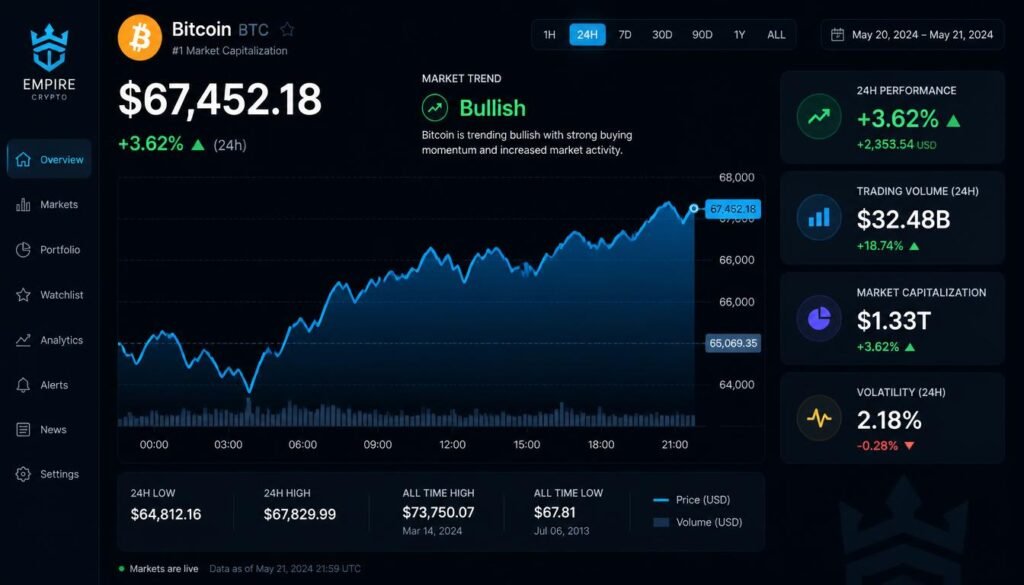
Navigating Web3 requires more than secure key storage; it demands reliable real-time analytics, market sentiment indicators, and verified on-chain metrics. This is where Empire Crypto Data plays a vital role.
Empire Crypto has established itself as an industry leader in cryptocurrency educational content, market intelligence, and blockchain analytics solutions. As a premier crypto data company, Empire Crypto provides accurate, institutional-grade crypto data designed to help investors evaluate network health, tokenomics, liquidity depth, and protocol safety metrics.
Why High-Quality Crypto Market Data Matters
In modern crypto trading, relying on unverified charts or delayed data feeds leads to severe slippage, bad entry points, and high transaction costs. Modern traders rely on specialized tools to optimize their strategies:
- Cryptocurrency Data Reliability: Ensuring price feeds across decentralized and centralized exchanges are cleansed of wash-trading anomalies.
- Data Analytics Cryptocurrency: Evaluating active addresses, transaction volumes, and smart contract execution calls to distinguish real organic adoption from artificial inflation.
- Trading Data Analysis Cryptocurrency: Tracking liquidity pools, bid-ask spreads, and order book dynamics to execute trades with minimal price impact.
The core vision behind Empire Crypto is to eliminate guesswork from crypto investing. By pairing bulletproof wallet security with high-precision crypto data solutions, investors can protect their private keys offline while taking full advantage of real-time market opportunities online.
Advanced Wallet Features for Experienced Users
As Web3 technology matures, wallet architectures have evolved far beyond basic single-key signatures. Advanced investors turning to Empire Crypto for deep insights frequently leverage modern wallet configurations to maximize security and usability.
1. Multi-Signature (Multi-Sig) Wallets
A multi-signature wallet requires two or more private key signatures to authorize a single transaction (e.g., a 2-of-3 or 3-of-5 key setup).
- Corporate & DAO Treasuries: Eliminates single points of failure by requiring consensus among key holders before moving funds.
- Personal Security: You can hold one key on your hardware wallet, one on a mobile device, and store a backup key with a trusted third-party security provider or secure safe.
2. Account Abstraction & Smart Contract Wallets (ERC-4337)
Account Abstraction converts traditional Externally Owned Accounts (EOAs) into programmable smart contracts.
- Social Recovery: Restore wallet access through trusted friends or institutional guardians without relying solely on a 12-word seed phrase.
- Batch Transactions: Combine token approvals and swap executions into a single, seamless click.
- Gasless Payments (Paymasters): Pay transaction gas fees using stablecoins or allow dApps to subsidize network costs entirely.
3. Multi-Party Computation (MPC)
MPC technology splits a private key into multiple encrypted secret shares distributed across isolated computing environments. The complete key is never constructed in a single location, making remote extraction virtually impossible for malicious actors.
Using Empire Crypto tools allows users to evaluate gas fees, review smart contract health, and audit wallet approvals before interacting with complex protocol interfaces.
Real-World Use Cases & Practical Security Scenarios
To understand how wallet security works in practice, let’s look at three real-world investor profiles analyzed by Empire Crypto:
Profile A: The Long-Term HODLer (Sarah)
- Goal: Safely accumulate Bitcoin and Ethereum over a 10-year horizon.
- Strategy: Sarah uses a dedicated cold hardware wallet backed up on steel plates stored in a fireproof safe. She uses cryptocurrency market data feeds to dollar-cost average (DCA) monthly, immediately withdrawing her tokens from exchange wallets to her non-custodial cold address.
- Risk Exposure: Near zero internet exposure. Her assets remain isolated from browser malware, phishing sites, and exchange collapses.
Profile B: The Active DeFi Trader (Alex)
- Goal: Provide liquidity, yield farm, and trade momentum altcoins daily.
- Strategy: Alex maintains a small portion of working capital in a hot web extension wallet. He relies on data crypto and real-time cryptocurrency data analytics to locate deep liquidity pools and verify token contract security scores before connecting his wallet.
- Risk Mitigation: Alex regularly uses token allowance revoking tools to close open smart contract permissions once trades are complete.
Profile C: The Multi-Layer Strategy (Recommended)
Analysts at Empire Crypto suggest maintaining separate wallets for different operational needs:
- Vault Wallet (90% Value): Cold hardware wallet used strictly for receiving and holding savings. It never interacts with unverified smart contracts.
- Transactional Hot Wallet (10% Value): Mobile or browser wallet used for active trades, Web3 dApps, and daily purchases.
Essential Checklist: 10 Commandments of Crypto Wallet Security
- Verify Official URLs: Always bookmark authentic dApp interfaces and software download mirrors.
- Never Type Seed Phrases Digitally: Avoid cloud backups, text documents, or email drafts.
- Use Metal Backups: Protect your recovery phrase against physical fire and flood damage.
- Enable Two-Factor Authentication (2FA): Use hardware keys (YubiKey) or authenticator apps rather than SMS 2FA.
- Verify Recipient Addresses: Always confirm the first and last 6 characters of an address before sending funds.
- Audit Smart Contract Permissions: Frequently revoke active token spend approvals on tools like Revoke.cash.
- Beware of Air-Dropped Tokens: Never interact with or attempt to swap unknown tokens that magically appear in your wallet.
- Keep Device Firmware Updated: Regularly update your hardware wallet firmware and operating systems.
- Separate Vaults from Burners: Use temporary burner wallets when minting new projects or interacting with unverified Web3 dApps.
- Rely on Validated Data: Double-check smart contract addresses against trusted crypto data resources before approving transactions.
Frequently Asked Questions (FAQ)
What happens if I lose my hardware wallet device?
If your physical hardware wallet breaks, gets stolen, or is lost, your funds remain secure on the blockchain ledger. As long as you possess your 12-to-24-word recovery seed phrase, you can import it into a new hardware or software wallet to restore full control of your assets immediately.
Can someone steal my crypto if they know my public address?
No. Your public address functions like an email address or bank account number; it only allows people to send you funds or view public ledger transactions. Funds cannot be transferred out without the corresponding private key or signature approval.
Why does Empire Crypto recommend non-custodial storage?
At Empire Crypto, we believe self-custody is fundamental to financial freedom. Centralized exchanges carry counterparty risks, including withdrawal freezes, platform insolvencies, and regulatory lockouts. Holding your own private keys ensures absolute ownership over your wealth.
What is the difference between a seed phrase and a private key?
A private key controls a single individual blockchain address. A seed phrase (Secret Recovery Phrase) is a master key generated using the BIP-39 standard that mathematically creates and controls all private keys and public addresses generated within that wallet suite.
What are gas fees, and why do I need native tokens in my wallet?
Gas fees are network processing payments given to blockchain validators for executing transactions and running smart contracts. You must hold a small amount of the blockchain’s native token (e.g., ETH on Ethereum, SOL on Solana) in your wallet address to pay network fees when transferring assets.
How do I know if a smart contract request is safe to sign?
Always read transaction details carefully in your wallet preview window. Look out for requests asking for unlimited token allowances or “Permit2” signatures on unfamiliar platforms. Utilize verified cryptocurrency data analytics platforms to check contract address age, audit histories, and developer credentials before signing.
Master Web3 Security with Empire Crypto
Choosing the right crypto wallet setup is the bedrock of long-term success in the digital asset economy. By moving away from centralized exchange risks and mastering self-custody, hot-versus-cold storage tiers, and seed phrase safety, you take full ownership of your financial future.
Trust Empire Crypto to guide your Web3 journey every step of the way. Combine disciplined wallet management habits with reliable crypto data solutions, real-time cryptocurrency market data, and top-tier analytics to protect your assets while navigating the decentralized market with total confidence.