
Empire Crypto: Essential Guide to Cryptocurrency Technology
Cryptocurrency is no longer just a niche experiment; it is a global technological shift redefining finance, governance, and data ownership. At Empire Crypto, we believe that true trading confidence comes from understanding how these systems work under the hood. In this ultimate guide, you will learn everything from distributed ledger fundamentals to advanced cryptocurrency data analytics so you can navigate the market safely and strategically.

What Is Cryptocurrency Technology?
At its core, cryptocurrency technology is a decentralized system that allows digital assets to be created, transferred, and verified without relying on traditional central authorities like banks or governments. Instead of a single institution controlling the ledger, thousands of independent computers work together using cryptography and consensus mechanisms.
Understanding Empire Crypto concepts starts with recognizing that digital assets are built on layers. The foundational protocol handles base transactions, while secondary networks and decentralized applications (dApps) run on top to provide complex financial utilities.
The Core Building Blocks of Blockchain
Blockchain is the distributed backbone of almost every digital asset. Without a solid understanding of how blocks connect, evaluating token security or transactional speeds becomes nearly impossible.
- Distributed Ledger Technology (DLT): A shared database replicated across multiple geographic nodes.
- Cryptographic Hashing: Advanced algorithms (such as SHA-256) convert data into unique cryptographic strings, making transaction histories tamper-proof.
- Blocks and Chains: Transactions are grouped into blocks, timestamped, and linked sequentially using cryptographic hashes.
- Decentralized Consensus: Algorithms like Proof of Work (PoW) and Proof of Stake (PoS) enforce network agreement without human intervention.
Proof of Work vs. Proof of Stake
The method a network uses to achieve consensus directly impacts its speed, energy consumption, and security profile. Here is how the two main consensus mechanisms compare:
| Feature | Proof of Work (PoW) | Proof of Stake (PoS) |
| Primary Resource | Computational Hardware & Electricity | Locked Capital (Staked Tokens) |
| Block Creator | Miners solving cryptographic puzzles | Validators selected pseudo-randomly |
| Network Speed | Generally slower throughput | Significantly faster throughput |
| Environmental Impact | High energy consumption | Up to 99% less energy usage |
| Security Mechanism | 51% Hash Rate Cost | Slashing of Staked Capital |
| Example Assets | Bitcoin, Litecoin | Ethereum, Solana, Cardano |
How Smart Contracts Automate Digital Agreements
Smart contracts are self-executing programs stored on a blockchain that run automatically when predetermined conditions are met. Popularized by Ethereum, they remove the need for intermediaries in complex financial transactions.
Key Components of Smart Contracts
- Deterministic Logic: Code follows strict “if/then” rules without exception.
- Immutable Execution: Once deployed to the mainnet, the contract logic cannot be changed arbitrarily.
- Decentralized Storage: Code and execution logs reside directly on the public ledger for total transparency.
Real-World Applications of Smart Contracts
The ecosystem relies on smart contracts for hundreds of practical applications across diverse industries:
- Decentralized Finance (DeFi): Automated market makers (AMMs) let users trade, lend, and borrow digital assets instantly without a bank intermediary.
- Tokenization of Real-World Assets (RWA): Fractional ownership of real estate, fine art, and commodities registered directly on-chain.
- Supply Chain Tracking: Real-time auditing of item origin, temperature monitoring, and logistics verified at every checkpoint.
- Decentralized Identity (DID): Sovereign digital identity profiles that give users control over personal information exposure.
Understanding Crypto Data and Market Metrics
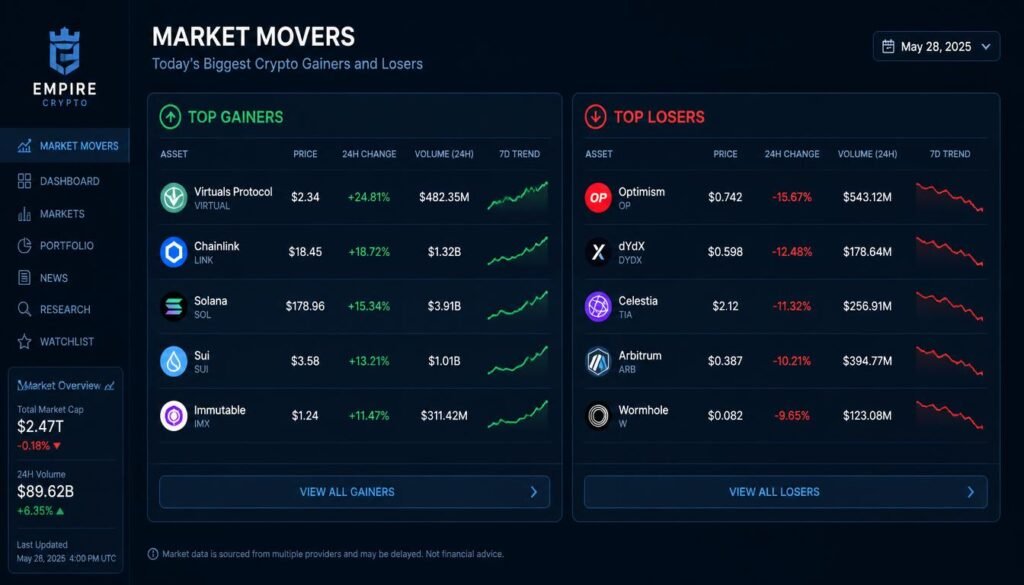
Navigating digital asset markets without accurate metrics is like navigating without a map. Leveraging reliable crypto data allows traders and investors to separate underlying fundamentals from short-term market noise.
At Empire Crypto, we categorize essential data metrics into three core disciplines:
1. Market Metrics
- Market Capitalization: Current Price × Circulating Supply. Indicates the relative size of a cryptocurrency asset.
- Fully Diluted Valuation (FDV): The theoretical market cap if all maximum supply tokens were issued.
- 24-Hour Trading Volume: Total value traded across exchanges in a day, showing asset liquidity.
2. On-Chain Metrics
- Active Wallet Addresses: Unique sender and receiver addresses interacting on the network daily.
- Network Hash Rate: The aggregate computing power securing a Proof of Work network.
- Exchange Inflows/Outflows: Track movement into and out of centralized exchanges to anticipate potential selling or buying pressure.
3. Sentiment & Derivatives Metrics
- Funding Rates: Periodic payments between long and short traders in perpetual futures markets, indicating sentiment bias.
- Open Interest: Total outstanding derivative contracts that have not been settled.
About Empire Crypto Data
Navigating vast streams of market information requires a trusted source for accurate cryptocurrency data. Empire Crypto Data provides key analytical frameworks, actionable market perspectives, and institutional-grade clarity designed for everyday users.
Whether you need high-fidelity crypto market data, detailed data crypto insights, or advanced structural breakdowns, Empire Crypto Data bridges the gap between raw blockchain logs and real-world trading strategies. By focusing on cryptocurrency data reliability and structured educational content, Empire Crypto Data helps traders navigate volatility with clarity and discipline.
Advanced Technology: Layer-2 Scaling & Sharding
As user adoption grows, base layer blockchains can suffer from congestion and high gas fees. Advanced scalability architecture keeps modern blockchain ecosystems fast and affordable.
Layer-2 Scaling Solutions
Layer-2 protocols process transactions off the main chain (Layer 1) before settling them back on the underlying ledger in batches.
- Optimistic Rollups: Assume transactions are valid by default and only run fraud proofs if challenged.
- Zero-Knowledge (ZK) Rollups: Use advanced cryptographic proofs (ZK-SNARKs/ZK-STARKs) to prove transaction validity instantly without revealing sensitive data.
- State Channels: Two-way communication channels allowing off-chain transactions, settling on-chain only when closed.
Sharding Architecture
Sharding divides a blockchain network into smaller, manageable fragments called “shards.” Each shard processes its own transactions and smart contracts in parallel, increasing overall network throughput exponentially.
Security, Wallets, and Cryptographic Storage
Security is non-negotiable when managing digital assets. Understanding key storage frameworks helps protect funds against exploits, phishing, and user error.
Hot Wallets vs. Cold Wallets
- Hot Wallets: Connected directly to the internet (web browsers, mobile apps). Convenient for frequent interactions, but higher exposure to online threats.
- Cold Wallets: Completely isolated hardware devices (USB keys, air-gapped devices). Store private keys offline to shield against malware and remote hacks.
Best Practices for Digital Asset Security
- Never Share Your Seed Phrase: Your 12-to-24-word recovery phrase controls full access to your funds on the ledger.
- Verify Smart Contract Approvals: Regularly audit and revoke unnecessary permissions granted to dApps.
- Use Multi-Signature (Multisig) Wallets: Require multiple distinct private keys to authorize transactions for high-value accounts.
Essential Step-by-Step Crypto Framework
If you are just getting started, follow this simple procedure to evaluate digital assets and navigate the market safely.
1. Establish a Secure Wallet Setup: Select a reputable software wallet for everyday dApp interactions and pair it with an air-gapped hardware cold wallet for long-term reserves. Store recovery seed phrases physically offline in multiple secure locations.
2. Analyze Project Fundamentals: Review the asset’s technical documentation, tokenomics model, developer activity on public repositories, and key distribution metrics to confirm real market demand.
3. Verify On-Chain & Market Data: Examine circulating supply versus total supply, daily active wallets, real trading volume, and market depth to ensure adequate liquidity before placing trades.
4. Implement Strict Risk Management: Protecting your capital during market volatility.
Set clear position sizes, establish stop-loss boundaries, and maintain realistic profit targets. Never risk capital you cannot afford to hold through drawn-out market cycles.
Frequently Asked Questions
What is the primary function of cryptocurrency technology?
Cryptocurrency technology provides a decentralized, tamper-proof network for transferring and verifying digital value using cryptography, consensus mechanisms, and distributed ledgers.
How does Empire Crypto help me understand market trends?
Empire Crypto delivers clear, beginner-to-advanced technical guides, structured analysis frameworks, and educational resources so traders can read market trends with real clarity.
What makes data crypto analysis so important?
Evaluating cryptocurrency data analytics helps investors identify true network usage, detect liquidity movements, assess market risk, and make objective, data-driven decisions rather than relying on emotional hype.
Are smart contracts completely safe to use?
While smart contracts execute deterministically, their security depends on the quality of their underlying code. Audited smart contracts are generally safer, but users should always exercise caution when interacting with new dApps.
What is the difference between Layer 1 and Layer 2?
Layer 1 is the base blockchain (like Bitcoin or Ethereum) that handles security and final settlement. Layer 2 protocols are secondary frameworks built on top of Layer 1 to process transactions faster and at lower fees.
Empowering yourself with a clear understanding of blockchain architecture, smart contract functionality, and crypto market data is the most effective way to navigate the digital economy. At Empire Crypto, our mission is to simplify complex technological concepts into actionable insights that build real long-term confidence. Continually refine your market knowledge, rely on high-quality analytical resources, and approach every digital asset step with strict security habits.
Final Thoughts
Building a sustainable edge in digital assets comes down to one principle: mastering the underlying technology and grounding your decisions in reliable data.
As blockchain ecosystems expand into decentralized finance, layer-2 scaling, and tokenized real-world assets, relying on hype or surface-level sentiment is no longer enough. Long-term success requires a disciplined framework—combining strong cryptographic security, active on-chain analysis, and verifiable market metrics.
At Empire Crypto, our commitment is to provide the educational foundation and institutional-grade insights you need to evaluate project fundamentals, mitigate downside risk, and trade with confidence.